Product added to your enquiry
How ground-level activities give children more ways to play
Uncategorized
16 Oct 2026
Not every playground activity needs to start with climbing a ladder or staircase. Ground-level play gives children opportunities to explore, invent games and play together, adding variety alongside the climbing and sliding.
For a school or community playground, we consider these activities as part of the layout from the start. Their position and surrounding surfaces affect who can reach them and how they connect with the rest of the play. That helps us decide whether an activity belongs within the play unit or in a separate space nearby.
Plenty to do without climbing up
Ground-level play can be active. A tunnel gives children a route to crawl through, while a marked trail can become a follow-the-leader game. Hopscotch and other surface games give children a reason to hop, jump or choose their own sequence. The ground itself can be part of the activity.
Sand play and ground-level musical panels offer a different pace, with room for children to experiment on their own or alongside others. These activities give children something to return to between more active play.
The NSW Government’s Everyone Can Play guidance encourages designers to consider sensory experiences and informal play alongside equipment. For a playground brief, that means looking beyond the main structure to what children can do with the surrounding space.
At Bayswater South Primary School, the Prep playground includes a sand pit, tunnel and stepping stones alongside play panels and a double slide. It’s a useful example of giving children several activities to move between within one play area.
Room for a game to develop
Some ground-level activities give children a starting point and leave the rest to them. A cubby might become a home or a meeting place for an invented game. Children decide what is happening, who is taking part and when the story changes.
Game panels offer a more structured activity, giving children a shared challenge and a reason to take turns.
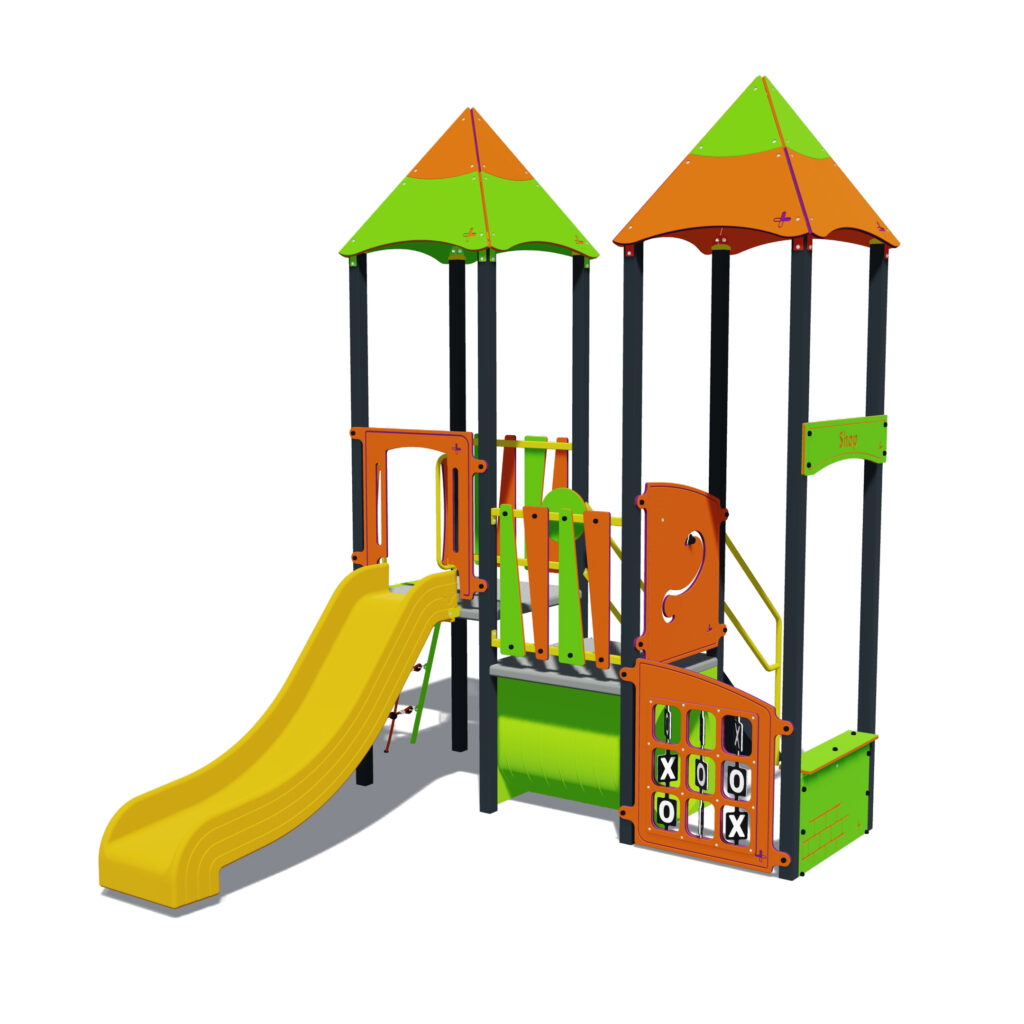
Both kinds of play can sit alongside an elevated structure. Our Pearcedale Play Unit, for example, includes a shop counter for pretend play and a tic tac toe panel at ground level.
Make the activities easy to join
Where an activity sits affects how children can use it. A panel on a busy route to a ladder may leave little room for a game to continue as others pass. A sand play area needs room around it for children to gather and work alongside one another. Those spaces need to be considered when the layout is taking shape.
Different activities also need different surroundings. A musical activity can invite children to play together, but placing it beside a spot intended for quiet play may make that quieter option less useful. Separation can help without putting children a long way from the rest of the playground.
Ground level doesn’t automatically mean accessible. The surface leading to an activity matters, as does the space to approach it and reach the parts used for play. A child may also need room for a carer to help. Sport and Recreation Victoria’s Design for Everyone Guide covers accessible routes and usable play components, with specific guidance for playgrounds.
You don’t need to resolve those technical details before discussing a playground. Tell us who will use the space and any access or support needs you know about. We can work through the layout, equipment and undersurfacing together.
Choose something that adds to the play
When reviewing a playground proposal, look at what a child could do if they stayed at ground level for the whole visit. Is there something to explore on their own? Is there room for a game with friends? Those questions help reveal whether the design offers real choice beyond climbing and sliding.
The answer will depend on what’s already there. A playground with a well-used sand pit may benefit from a different activity, while a site dominated by climbing equipment may need more space for imaginative or shared play. Our guide to planning a balanced mix of play explores those wider choices.
For a new playground or an upgrade, talk to an adventure+ play consultant about what children enjoy now and what you’d like them to be able to do. That gives us a useful place to start the design.



© 2026 Adventure Playgrounds Pty Ltd. All rights reserved. ABN 28 120 543 259 / ACN 120 543 259